You've come to the right place if you wish to see how life is like living for 3 months as a foreigner in Osaka. I'll keep you posted on everything that makes Japan famous to the world: from used schoolgirl panties sold in vending machines to anime blowup dolls. Enjoy!

Monday, August 08, 2005


A shot of dowtown Nagoya, in front of Sakae station, in the evening.  Posted by Picasa


I thought it would be cool to take a photo with a chick wearing a Yukata. I just love the way they look in them. Posted by Picasa


Shut up. I HAD to put on the armor. I passed by the little stand, and figured "When will I ever get another chance to actually dress up like a Samurai?" Everyone kept calling me "Last Samurai", well, "Rast Samurai" actually. I could not pass up the opportunity to put on the armor and run around as an actual Samurai. The katana is actually real, which added a great deal to my little fantasy. I didn't want to take the thing off either until they pretty much undressed me while I was still greeting onlookers with my Samurai talk. Ahh.. what fun. Posted by Picasa


Because I refused to give in to doing the mandatory peace sign while having my picture taken, I was forced to commit ritual suicide (seppuku).  Posted by Picasa


A view from the top of Nagoya Castle. Posted by Picasa


Like Osaka Castle, Nagoya Castle was also reconstructed after being set ablaze by firebombs during World War Two. It really is a shame that there are very few original structures outside of Kyoto.  Posted by Picasa


A statue of a Samurai which greets visitors of Nagoya castle. Posted by Picasa


Visitors of the mall near Nagoya bus terminal in Sakae were treated to a traditional Japanese musical performance. The music was actually really great, and catchy. I have a clip of them playing if any of you are interested.  Posted by Picasa


Another view of Sakae from atop the Nagoya tower. Posted by Picasa


A view of downtown Nagoya (Sakae) from atop the Nagoya tower.  Posted by Picasa


My trip to Nagoya begins with a photo of Nagoya tower. There is something about large towers that fascinates the Japanese, and it's almost as if every city has one. I wonder if they're just overcompensating for something... Posted by Picasa


An photo of the garden behind Kofukuji temple.  Posted by Picasa


Photo taken inside the main image hall of Kofukuji temple. The two standing protector Boddhisattvas represent a dramatic Japanese style in sculpting, but the bronze Buddha in the background looks to be of archaic Chinese style. Am I right, Alex? Posted by Picasa


The main image hall of the very beautiful Kofukuji temple.  Posted by Picasa


The abundance of the color red clearly represents the Chinese influence on this particular temple. Nagasaki was the only area in Japan that was still being influenced by Chinese art after the rest of the country abandoned it and concentrated on their own unique style.  Posted by Picasa


I realize I disturbed the bronze monks by barging in on them, but I tried to make it up by telling them a joke about Jesus, Buddha, and Mohammed on an island. Either they didn't get the punch line or were insulted by it. I didn't want to linger around much longer to find out. Posted by Picasa


Buddhist images in the Chinese-style Sokufuji temple. Alex, tell us a little something about the artwork. I don't remember all that much from Professor Lin's class. Heh. Posted by Picasa


What's left of a catholic church which lay right near the hypocenter. It's amazing that any part of that church is still standing. Posted by Picasa


Behind the glass is the ground level at the time of the atomic bombing. In case you were too lazy to read the caption on the left, I wrote it out for you. Lazy ass. Posted by Picasa


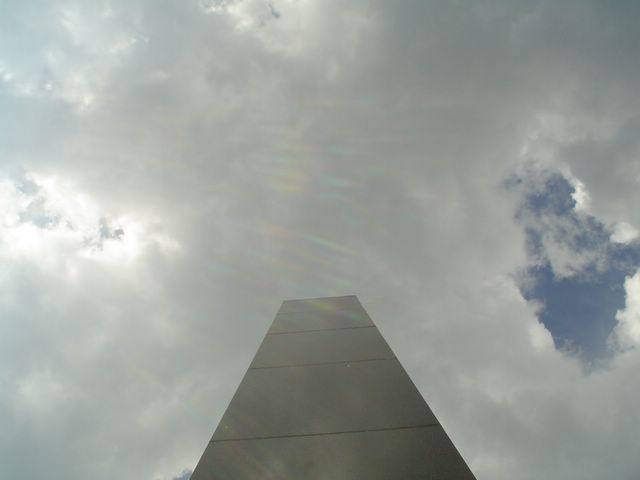
The spire was errected right at the point of the bomb's detonation, so I took a picture of the sky from which the bomb fell. Eerie, isn't it? Posted by Picasa


I'm standing right on the hypocenter where the atomic bomb ignited back in 1945, thus ending the war in the Pacific. I couldn't help but feel a little guilty about the mass devastation caused by the atomic bomb, and the pictures I've seen at the atomic bomb museum really moved me. While I don't disagree with our decision to use the bomb at the time, the result was devastating. The atomic bomb completely obliterated the entire city of Nagasaki, causing the deaths of nearly 80,000 people, and leveling every building within a 2 mile radius. War's hell. Posted by Picasa


A miniature model of how Dejima, an artificial island built in the Edo period to house foreign (primarily Dutch) traders, looked in its hey-day. What makes Nagasaki famous is that it was the only port open to foreign trade during the time when Japan closed itself off from the rest of the world.  Posted by Picasa


I'm the one on the left. Posted by Picasa


A view from the inside of Oura Catholic Church. Posted by Picasa


Oura Catholic Church near Glover garden in Nagasaki. Nagasaki is home to the largest catholic population in Japan, in large part due to the work of Portuguese missionaries like St. Francis Xavier in the 1500s. Catholics were purged and the missionaries driven out by Oda Nobunaga in the mid 17th century, but many of the converted Japanese survived.  Posted by Picasa